

Bentonite
Bentonite is a retentive expanding clay that mainly contains montmorillonite. Typically, it forms when volcanic residue weathers in seawater, which turns the volcanic glass found in the residue to earthy minerals. Bentonite beds are white, pale blue, or green in color when they are under a fresh environment. When the environment is weathered more, they turn to cream and afterward yellow, red, or earthy brown colors.
It can absorb a huge portion of water, which increases its volume as a result. Hence, these are not used for building and road construction. But its swelling quality deems useful in drilling groundwater sealants and mud. Montmorillonite being an aluminum phyllosilicate mineral takes the structure of tiny platy grains. All these properties make the clay cohesive, which is used as a binder and an add-on in pottery making clay, kaolinite.
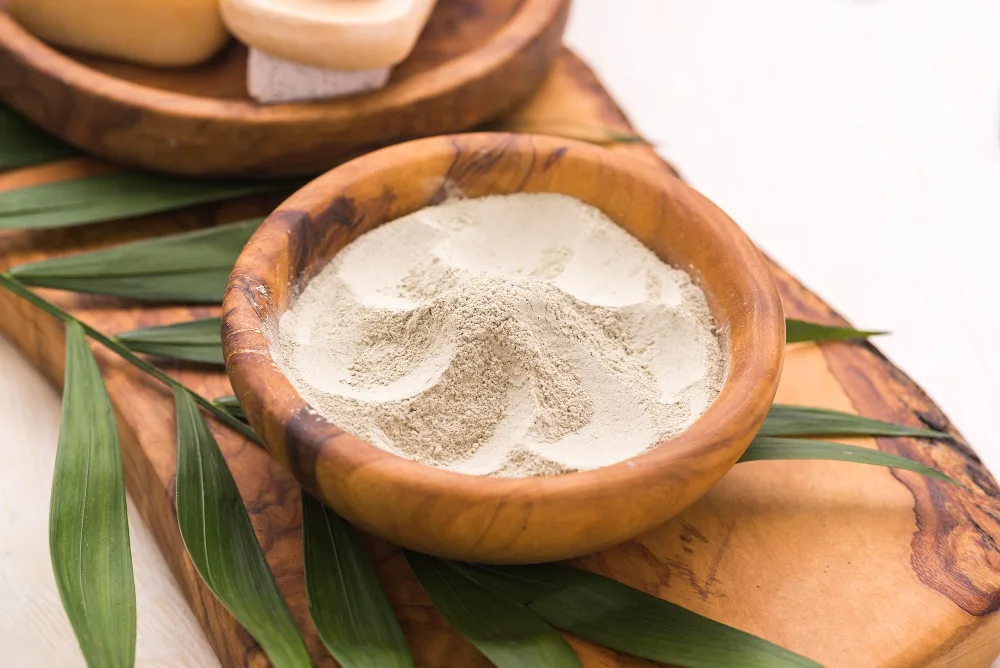
Bentonite Uses:
Drilling mud:
The utilization of bentonite comes in drilling mud for lubrication and cooling of the tools used for cutting, elimination of cuttings, and in prevention of blowouts.
Binding:
Bentonite is greatly used in the form of a foundry-sand binder in iron and steel factories. Sodium bentonite is normally used in massive castings that utilize dry molds, whereas calcium bentonite is used in small-scale castings with wet molds. Bentonite also serves as a binder in the production of iron ore (taconite) pellets in the steelmaking industry. Both homemade and commercial clay figures, as well as ceramic glazes, contain small amounts of bentonite, which increases flexibility and reduces settling, making them easier to work with.
Filler:
Bentonite is used as a filler in a variety of products, including paint, adhesives, rubber, cosmetics, and soaps. It stabilizes and enhances these products.
Sealant:
Sodium bentonite’s property of expanding in water makes it an ideal sealant, acting as a self-sealing and low-permeability barrier. It is used to line the foundations of landfills to prevent leachate migration, isolate metal pollutants in groundwater, and secure underground disposal systems for spent nuclear fuel.
Catalyst:
High-quality calcium bentonite is used as a catalyst in breaking down heavy petroleum fractions by treating them with acid.
Medical:
Bentonite is a base for many dermatologic formulations. Bentonite desiccants are widely used to protect diagnostic, nutraceutical, and pharmaceutical products from moisture degradation, extending their shelf life. Bentonite complies with FDA regulations for use in food and drugs.
Emergency Use:
Bentonite is used in industry and emergency response as a chemical absorbent and container sealant.
Purification:
Bentonite is used to decolorize various animal oils, vegetables, and minerals. It is also used in refining vinegar, liquor, wine, beer, cider, and mead. Due to its ability to absorb large amounts of protein particles, bentonite is particularly useful in removing excess protein from white wines and promoting quicker purification of red wines.
Absorption:
Bentonite is an effective absorbent in pet care products like cat litter, absorbing pet waste. It is also used to absorb oils and grease.
Carrier:
Bentonite acts as an inert carrier for pesticides, fertilizers, and fire retardants. It helps ensure the uniform dispersion of the active agent and retains pesticides and fertilizers on plants.
Farming in Thailand:
Farmers in Northeast Thailand have adopted clay technology, using bentonite clay to reverse soil degradation and achieve significant economic returns. The use of bentonite clays has successfully increased yields of forage sorghum grown under rain-fed conditions and improved farmers’ incomes.
Bentonite Slurry Walls:
Bentonite slurry walls are used in construction to stabilize trenches that would otherwise collapse due to hydraulic pressure in the surrounding soil. Concrete and rebar structures can be assembled in a slurry-filled trench, and then concrete is poured into the structure. The heavier liquid concrete displaces the less dense bentonite slurry, which overflows and is then recycled for use in a new trench.
Pottery:
A small amount of bentonite is often added to clay blends to increase plasticity, making it easier to form using techniques like throwing on a potter’s wheel and hand building. Bentonite is also commonly found in ceramic glazes to prevent settling and improve the evenness of application on bisque-fired ware.
Types of Bentonite Powder at Soventis Group:
Foundry Grade Bentonite Powder Specification:
| Properties | Protocol | Unit | Result |
|---|---|---|---|
|
Free Swelling Volume 2 gm/100ml |
ASTM D 5890:1995 |
ml |
32-34 |
|
Methylene Blue Absorption Value |
API spe 131:2004/ ISO 10416:2002 |
mg/gm of clay |
400 – 450 |
|
Liquid Limit |
IS:12446-1988 |
ml/100 gm
|
600 – 700 |
|
Gel Time 2.5gm/25 ml |
IS:12446-1988 |
second |
Instant |
|
Gelling Index |
IS:12446-1988 |
ml |
85-90 |
|
Moisture Content % by weight |
API Spec. 13A:2004/ ISO 13500: 1998 |
% |
10.0 – 12.0 |
|
PH Value 2% slurry |
IS:6186-1986 |
pH |
9.5 – 9.9 |
|
Green Compression Strength Bentonite: Water: 10:4 55-60 A.F.S Sand |
IS:12446-1988 |
psi |
12.5 |
|
Wet Tensile Strength |
IS:12446-1988 |
N/cm2 |
0.16-0.20 |
|
Dry Mesh % Passing 200 B.S.S |
IS:6186-1986 |
% |
85 Minimum |
1.FOUNDRY GRADE BENTONITE POWDER
Almost all the cast iron, steel & malleable iron foundries are making use of Bentonite with cost-effective results. The Kutch region is well-known for high quality sodium bentonite used in casting industries. Even for consistent mould-making, Kutch Bentonite is potently used. Our Bentonite powder is foundry-grade, and it gives a proper ability to flow, along with compact potential and thermal stability for the manufacturer of good quality castings.
We maintain the below parameters that help us make top-grade castings:
- High gelling time that provides enhanced strength in less mulling time
- Maintaining pH
- Active clay maintenance
- Quality strength on competent compatibility
Api 13a Section – 4 Grade Bentonite Powder Specification:
| Properties | Protocol | Unit | Required | Result |
|---|---|---|---|---|
|
Viscometer Dial Reading at 600 rpm |
API Spec. 13A:2004/ ISO 13500: 1998 |
r/min |
32-34 |
34 |
|
Yield Point / Plastic Viscosity Ratio |
API Spec. 13A:2004/ ISO 13500: 1998 |
– |
3 Max |
2.85 |
|
Filtrate Volume |
API Spec. 13A:2004/ ISO 13500: 1998 |
ML |
15 Max |
14.4 |
|
Moisture Content |
API Spec. 13A:2004/ ISO 13500: 1998 |
% By weight |
10.0 max. |
10 |
|
Dry Screen Analysis (Residue Greater than 75 Microns) % |
API Spec. 13A:2004/ ISO 13500: 1998 |
% By weight |
4.0 max. |
3.0 – 4.0 |
2.DRILLING GRADE BENTONITE POWDER
Bentonite is useful as a mud element for oil and water well drilling. Its major role is to close the borehole walls, eliminate drill cuttings, and grease the cutting head. The particular higher mud yield consequently uses less quantity of Bentonite for the same usual mud. This leads to a lesser need of Bentonite in this process.
- Preserves thixotropic properties when it comes in contact with brine and high temperature during deep drilling
- Provides excellent barrel yield
- Withstands formation pressure
Container Capacity of Bentonite Powder:
| Type of Container | Quantity | Packing |
|---|---|---|
|
20’ FCL |
28MT |
50 Kg Packing Jumbo Packing as Per Client Requirement |
|
40’ FCL |
– |
– |